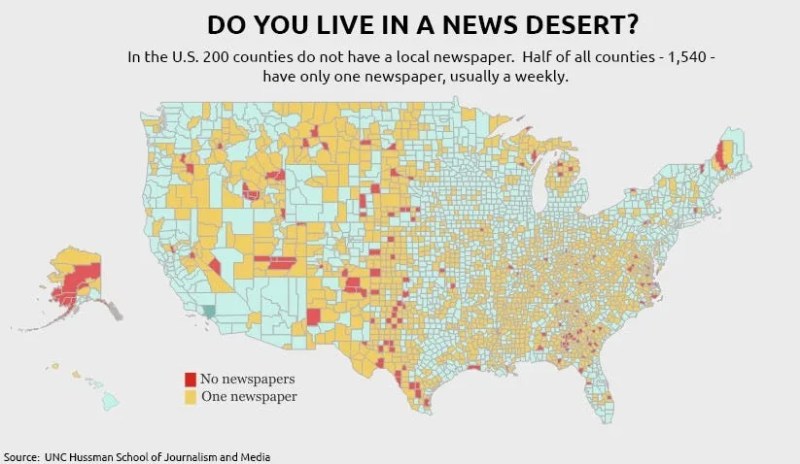
Since 2005, more than 2,500 newspapers across the US have closed. That’s left some 70 million Americans with either no local news organization or only one.
The decline of local journalism can be felt here in Wisconsin too, of course. In the Northwoods, Rhinelander’s local paper used to print a new edition every day. Now, it’s twice a week. Commercial radio stations have eliminated their local news cut-ins, too.
RELATED: Two Local Papers Die Every Week in the US
If you’re reading this, you likely see the problem that many people overlook. Less local news coverage leads to more political polarization, less accountability for local officials, and lower voting rates, as proven by many studies like this one from Harvard.
What’s the fix?
Investing in free newsletters like ours (sign up here!) is helpful, as well as public radio. And the government could do more to help, considering just how important free press is to a healthy democracy. In 1967, Congress created a nonprofit called the Corporation for Public Broadcasting to support local newsrooms. But as inflation’s gone up, the nonprofit’s contributions haven’t.
Right now, the US government contributes about $3 per capita per year to public news outlets like NPR. Other Western democracies spend more than $50 per capita.
No state has been spared the death of a newspaper, but the Midwest is among the hardest hit regions. According to this study of “news deserts,” states in the South, Midwest, and Rocky Mountains were most likely to have counties with only one local paper.