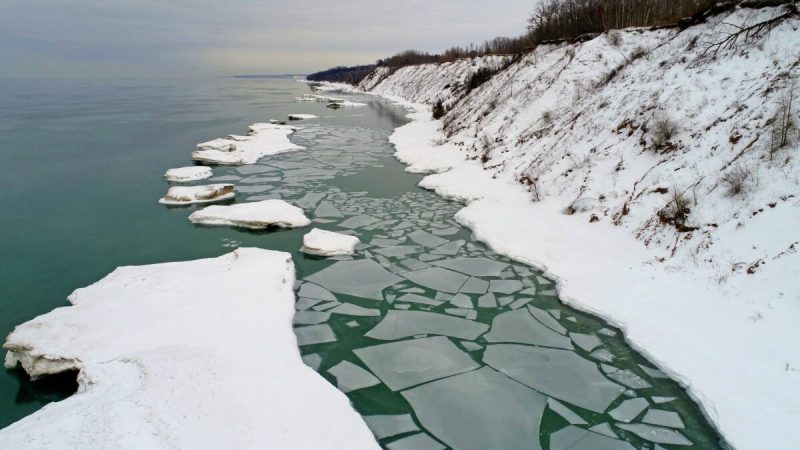
It looks like the Great Lakes region might get another relatively normal ice year − a relief given recent trends.
The U.S. National Ice Center released its 2025-2026 seasonal outlook this week, predicting near normal ice conditions across the Great Lakes. If the predictions turn out to be accurate, it will be a second year in row of normalcy – which isn’t actually that normal anymore as ice cover has been declining for the past half century mixed with extreme year-to-year swings.
During the 2024-’25 season, average ice cover across the Great Lakes was 18.3%, according to the National Oceanic and Atmospheric Administration, or NOAA. Averages are calculated each season across the Great Lakes from January through March. Maximum ice cover hit about 52%, in line with the long-term average.
Another year of normal conditions would be a reprieve. Winter is the fastest-warming season in the region, becoming increasingly warmer and wetter, with less snowfall. The season has shortened by several weeks. Changes are even happening to the lakes themselves. For instance, a study published earlier this year found that Lakes Michigan and Huron don’t consistently separate into layers − or stratify − in the winter anymore.
The previous few years have brought lower ice cover, which can threaten the region’s $7 billion fishing industry and coastal infrastructure as well as incite harmful algae blooms later in the year.
In 2023-’24, the Great Lakes saw the lowest average ice cover on record since scientists began recording ice cover more than 50 years ago, according to data from the National Oceanic and Atmospheric Administration. Average ice cover that year was 4.3%, which was only the second time cover did not reach 5%. The 2023 season was the fourth lowest on record.
Here’s what to know about the 2025-’26 Great Lakes ice forecast.
Near normal ice conditions across the Great Lakes
The ice center predicts slightly below normal to near normal ice cover for all of the lakes. Here are more specific predictions:
- Lake Superior: Above normal ice conditions are forecast for Lake Superior.
- Lake Michigan: Near normal ice conditions are forecast for Lake Michigan.
- Lake Huron: Near normal ice conditions are forecast for Lake Huron and Georgian Bay.
- Lake Ontario: Slightly below normal ice conditions are forecast for Lake Ontario.
- Lake Erie: Near normal ice conditions are forecast for Lake Erie and Lake St Clair.
Wisconsin’s bay of Green Bay in Lake Michigan
Here is the ice forecast for the bay of Green Bay:
- Early to mid-January: Consolidated thin to medium lake ice along the shore in the Bays de Noc and in the southeastern section.
- Late January: Medium lake ice except consolidated medium lake ice in the Bays de Noc and in the southern section.
- Early to mid-February: Medium lake ice except consolidated medium and thick lake ice in the Bays de Noc and in the southern section.
- Mid- to late February: Consolidated medium and thick lake ice.
Wisconsin’s Chequamegon Bay, Apostle Islands in Lake Superior
Here is the ice forecast for Wisconsin’s Lake Superior shoreline:
- Early January: Open water with thin lake ice along the shore and within the Apostle islands. Consolidated thin and medium lake ice in Chequamegon Bay.
- Mid-January: Thin lake ice along the shore and within the Apostle islands. Consolidated medium and thick lake ice in Chequamegon Bay.
- Late January: Thin lake ice except consolidated medium lake ice along parts of the shore and within the Apostle Islands. Consolidated thick lake ice in Chequamegon Bay.
- February: Thin and medium lake ice except consolidated medium lake ice along parts of the shore and within the Apostle Islands. Consolidated thick lake ice in Chequamegon Bay.
Great Lakes ice maintains ecosystem health, recreation, infrastructure
The impacts of low ice cover are far-reaching, and what happens in the winter matters for the rest of the year. Here is why ice cover is so important for the Great Lakes.
- Lake levels: If lake levels are too low, it can lead to lower lake levels later in the summer as the lakes warm faster, leading to more evaporation. But lake levels also depend on other factors, like rainfall.
- Lake-effect snowstorms: Late fall, early winter is primetime for lake-effect snow when the lakes are still relatively warm, and have little to no ice cover. Lake-effect snowstorms occur when cold, dry air travels over open water, sucking up moisture that is released when the air mass hits land.
- Shoreline erosion and infrastructure: Ice tempers waves during winter storms. Waves are larger when there is less ice, which can lead to lakeshore flooding and erosion. Ice helps protect infrastructure, like intake valves, during storms, as well.
- Fisheries: Ice protects populations of fish that spawn in the fall in the nearshore areas. Ice protects fish eggs by suppressing winds and waves that can stir up the sediment, reducing the number of fish that hatch in the spring.
- Food web: Less ice and warmer waters can cause phytoplankton − microscopic plant-like organisms that form the base of many aquatic food webs − to bloom earlier than the zooplankton that feed on them. If there are no zooplankton around, there can be a ripple effect up the food chain, especially on the fish that depend on zooplankton.
- Water quality: Warmer waters and less ice can create the perfect conditions for blue-green algae blooms later in the summer. These blooms suck up oxygen and block sunlight, which makes it harder for aquatic life to survive.
Caitlin Looby covers the Great Lakes and the environment for the Milwaukee Journal Sentinel. Reach her at clooby@gannett.com and find her on X @caitlooby. All of her work and coverage decisions are overseen solely by Journal Sentinel editors.
Caitlin is an Outrider Fellow whose reporting also receives support from the Brico Fund, Fund for Lake Michigan, Barbara K. Frank, and individual contributions to the Journal Sentinel Community-Funded Journalism Project. The project is administered by Local Media Foundation, tax ID #36‐4427750, a Section 501(c)(3) charitable trust affiliated with Local Media Association.
Learn more about our community-funded journalism and how to make a tax-deductible gift at jsonline.com/support. Checks can be addressed to Local Media Foundation with “JS Community Journalism” in the memo, then mailed to: Local Media Foundation, P.O. Box 85015, Chicago, IL 60689.
This article originally appeared on Milwaukee Journal Sentinel: The 2025-’26 Great Lakes ice forecast is out. What’s in store?
Reporting by Caitlin Looby, Milwaukee Journal Sentinel / Milwaukee Journal Sentinel
USA TODAY Network via Reuters Connect