Year-round crop production in cold climates requires structures that provide favorable growing conditions during cold winters with short days and low light conditions. Deep winter greenhouses (DWGs) and geodesic dome greenhouses (GDGs) are promising systems for extending the growing season and supporting local food production in cold northern areas. Both systems use low-energy, passive designs to reduce heating needs while maintaining suitable growing conditions for crops.
Deep winter greenhouses fit the bill for frigid Midwestern winters
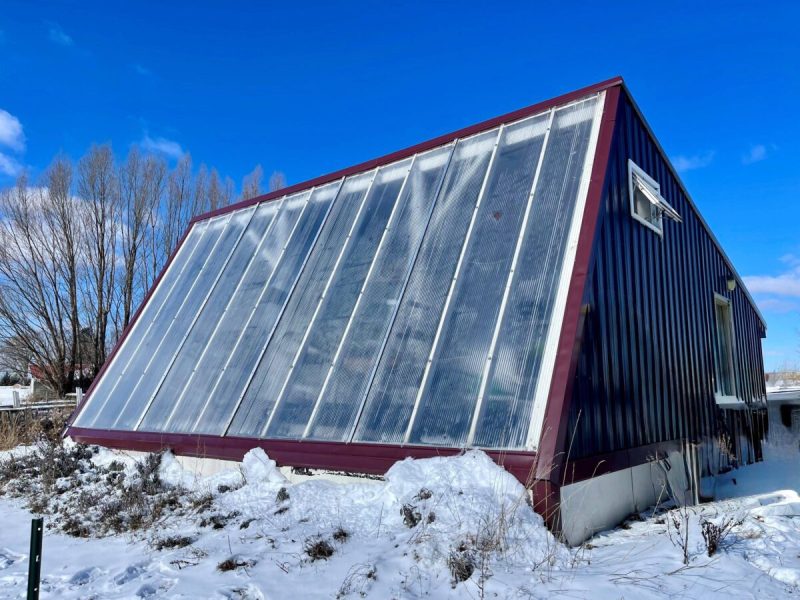
The Deep Winter Greenhouse (DWG) design, developed by University of Minnesota Extension (https://tinyurl.com/24v5jcep), features an insulated structure with a south-facing glazing wall at a 60° angle to efficiently capture sunlight, even on the shortest days of winter. Daytime heat is stored by funneling warm greenhouse air through a thermal mass of rock under the structure. At night, the rock gradually releases heat to maintain stable greenhouse temperatures, eliminating the need for supplemental winter heating.
As DWGs have been operating successfully across Minnesota, we recently tested how the DWG design would perform under Wisconsin conditions using computer simulations. In winter, average air temperatures are about 17 °F in Minnesota (Cook County) and 23 °F in Wisconsin (Grant County). Although outdoor temperatures often fall below freezing, soil temperatures at a depth of 40 inches, where the rock bed is located, remain above freezing (36.9 °F in Minnesota and 39.6 °F in Wisconsin).
Since both states receive similar levels of solar radiation during winter, DWGs have strong potential for crop production during Wisconsin’s cold winters. In summer, well-insulated DWG structures trap excessive heat, leading to interior temperatures over 95 °F. Ventilation fans are needed to remove hot air to maintain a suitable summer growing environment. Solar-powered ventilation systems provide renewable energy options for ventilation and air movement in DWGs.
Design of geodesic dome greenhouses offers many benefits
Geodesic dome greenhouses (GDGs) offer another design option. A dome’s aerodynamic, spherical shape minimizes heat loss and maximizes wind tolerance, while providing uniform light distribution. An important feature of geodesic dome greenhouses is an above-ground pond for heat storage. The design takes advantage of seasonal variation in the sun’s angle.
During winter, low-angle sunlight falls on the insulated north wall, reflecting light toward the pond and warming it up. The pond’s stored heat is gradually released at night, warming the greenhouse. In summer, when the sun is higher in the sky, the north wall remains shaded, preventing excessive warming.
In addition to the pond, the system also uses a fan to draw air from the pond area through pipes buried under raised beds along the greenhouse perimeter. This circulation pathway transfers stored heat into the soil, promoting stable root-zone conditions during colder periods. In summary, although GDGs do not eliminate heating needs entirely, they provide a substantial reduction during winter and contribute to more stable energy use throughout the year.
Nesli Akdeniz is the Controlled Environments Extension Specialist and Allen Pyle is a Horticulture Outreach Specialist for UW-Madison Division of Extension
This article originally appeared on Wisconsin State Farmer: Greenhouse designs provide opportunity for year-round crop production in WI
Reporting by Nesli Akdeniz and Allen Pyle, Wisconsin State Farmer / Wisconsin State Farmer
USA TODAY Network via Reuters Connect