After a canceled shipbuilding program in Marinette, Trump’s desire for namesake battleships could outsource the job to South Korea.
Only a month after canceling the construction of Navy frigates in Marinette, President Donald Trump is demanding a new “Trump class” of warships with bells and whistles not yet proven to be added to the US fleet. The size of the new ships could also lead to would-be Wisconsin jobs being outsourced to facilities in South Korea.
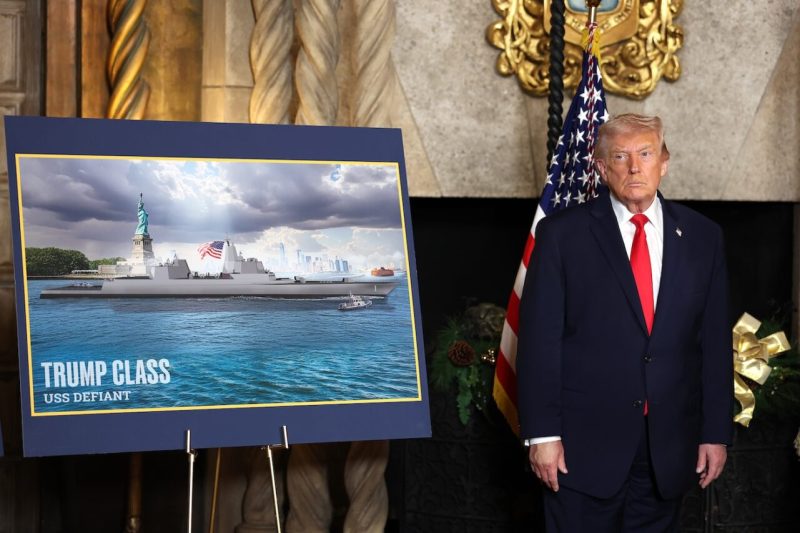
Plans announced Monday at Trump’s Mar-a-Lago compound call for a “Golden Fleet” of new battleships to be armed with hypersonic missiles, nuclear cruise missiles, rail guns, and high-powered lasers — though the Navy has struggled to field those technologies.
In one illustration, a larger-than-life image of Trump is painted on each boat’s helicopter hangar, and Trump has said he will have a direct role in its design “because I’m a very aesthetic person.”
While the battleships are a vanity project for an American president, it is possible that they may not be built by American workers. As it stands, US shipbuilding is a shell of its former self. Current shipyards are plagued with shortages of skilled workers. Still, Trump and US Navy Secretary John Phelan said they would begin discussions with defense contractors to advance an extremely ambitious timetable given that naval shipbuilding is already unable to meet scheduled demand.
Marinette loses frigate contract
The Maritime Executive industry newsletter notes that Fincantieri Marinette Marine shipyard isn’t large enough to build this new class of “Trump” battleship. It is currently building the only two Constellation-class frigates and won’t deliver others, after the administration canceled the line due to years of delays and cost overruns caused by repeated design changes by the Navy and its contractors.
The administration last week announced it would order a different type of frigate, the FF(X), which would be built by Huntington Ingalls Industries in Pascagoula, Mississippi. But Tom Nelson, the author of a book about the decline of shipbuilding in Wisconsin and nationwide, said the Pentagon would be wrong to take the shipyard in Marinette for granted.
“The military sooner or later is going to need Fincantieri Marinette Marine to build a ship,” said Nelson, who is the Outagamie County Executive. “And so we have to make sure that we have these established companies [and] a workforce that when it is needed, they’re there.”
Sen. Tammy Baldwin (D-Wisconsin) blasted the change in frigate plans, accusing the administration of turning its back on thousands of skilled Wisconsin workers without any guarantee of better results.
“If the Trump administration insists on building a new frigate,” Baldwin said, “then I call on the Navy to uphold its promise to Wisconsin’s shipyards, communities, and workers and ensure that some of these ships are built here in Wisconsin. Additionally, using any of the Navy’s money meant to build the Constellation-class in Wisconsin for this new frigate without the approval of Congress is illegal. It is only fair for the Trump administration to use every dollar meant to build the Constellation-class in Wisconsin for other Made in Wisconsin ships.”
Unproven bells and whistles
In typical Trump fashion, the president made hyperbolic claims about his namesake vessels, starting with one he’s naming the USS Defiant.
“They’ll be the fastest, the biggest, and by far 100 times more powerful than any battleship ever built,” Trump claimed.
Data obtained by US Naval Institute News suggests a ship nearly 900 feet in length and crewed by up to 850 sailors — containing two five-inch cannons, one railgun, 128 missile launching cells, 12 larger cells for hypersonic missiles, and two anti-missile lasers. Trump also said that the ship would be equipped with the Nuclear-Armed Sea-Launched Cruise Missile (SLCMN), a tactical nuclear weapon program expected to deliver in the mid-2030s.
But the Associated Press notes the Navy spent hundreds of millions of dollars and more than 15 years trying to field a railgun aboard a ship before abandoning the effort in 2021. Laser technology has seen more success in making its way onto Navy ships in recent years, but its employment is still limited. And deploying nuclear cruise missile capabilities on ships may violate non-proliferation treaties that the US has signed with Russia. That’s all on top of the difficulties getting the Ford-class aircraft carrier and Columbia-class submarines developed. Both are behind and over-budget.
Building battleships overseas?
If there continues to be a backlog of work, supply chain delays, and a small skilled workforce, the ships could end up being built in South Korea. Trump recently signed a trade agreement that includes $150 billion in “maritime investment.”
Regardless of location, Trump’s tough talk about competing on the seas with China can’t overcome the current imbalances. China has an estimated 400 hulls in the water, according to the International Institute for Strategic Studies — while the US has around 240 ships and submarines.
China has more than 300 shipyards. The US Navy has eight.
For Marinette, the day-to-day struggle is local, but long-term impact will be felt nationally.
“When they pull these contracts out and they don’t do their job, which is to make sure that these ships are up to spec and what they need, then this is going to be bad for Fincantieri Marinette Marine, for the workers in Marinette, but also for the US Navy,” Nelson said.