The two leading candidates for governor are courting Wisconsin farmers, but one says the other’s rural record is “ridiculous.”
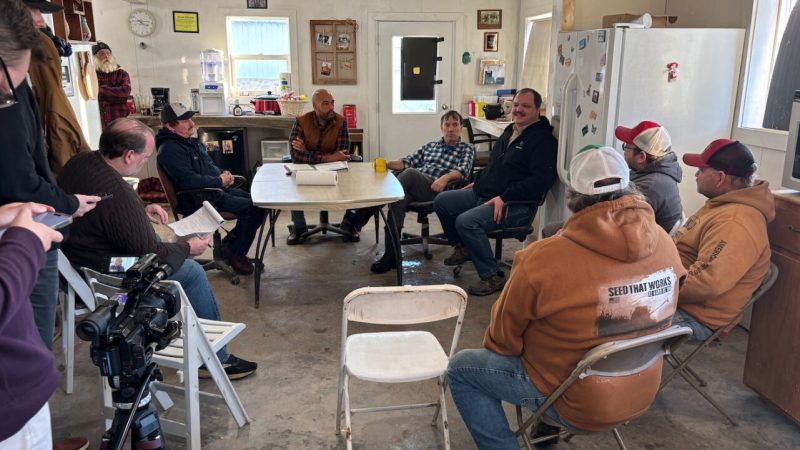
Former Lt. Gov. Mandela Barnes says even someone like him from a big city like Milwaukee can see how bad the Republican record has been for rural Wisconsin, especially family farms. Barnes, a Democratic candidate for governor, pointed to skyrocketing healthcare costs, punishing tariffs, and unchecked corporate market power during a visit to a farm in Chippewa County.
The area around Cadott is currently represented in Congress by US Rep. Tom Tiffany, the leading Republican candidate for governor. But Barnes says there’s nothing in Tiffany’s experience that has been beneficial to his constituents or the rural economy.
“The idea that someone wants to be governor who’s put our small family farmers on the back burner time and time again is pretty ridiculous,” Barnes said. “Whether it’s migrant labor or healthcare, he has failed us time and time again.”
Barnes visited with a half-dozen local farmers in one of their barns, listening as they outlined the ways Washington has failed them and how they want a Wisconsin governor who will be on their side. They told Barnes about getting market prices for their crops now that are similar to what their parents were getting decades ago, meaning there has been no growth to account for inflation. For example, farmers could get a little under $3 per bushel of corn in the 1980s and it’s not much above $4 per bushel today.
Market prices used to support a farm family, but the farmers who talked to Barnes outlined the extra jobs they’ve had to take on to prevent losing their livelihoods.
“Our small family farmers are the backbone of Wisconsin’s agricultural economy,” Barnes said. “Folks just want to be respected and compensated for the work they do. And that’s pretty reasonable to me. That feels like a simple and fair ask.”
Barnes acknowledges the frustration farmers are feeling over President Donald Trump’s trade war tariffs that are cutting off export markets — farmers say they’d rather have open markets than multi-billion dollar taxpayer-funded bailouts.
Insult was added to injury by a president and Congress that refused to keep tax credits in place that had been helping farm families afford health insurance.
“Folks are talking about the increase in healthcare premiums going up from about $300 to $1,300 and deciding to forego health insurance altogether,” Barnes said. “Creating another risk is ridiculous. People have written to him, people have pleaded with Tom Tiffany about voting to extend those tax credits [which] fortunately the House did pass, but Tiffany wasn’t one of the people who took a vote to make life easier for people.”
WATCH: Derrick Van Orden’s vote to support ACA tax credits was not a change of heart.
Barnes said, as governor, he would continue to seek new markets for Wisconsin agricultural products and reform corporate tax loopholes that were originally designed to protect farm families and small manufacturers.