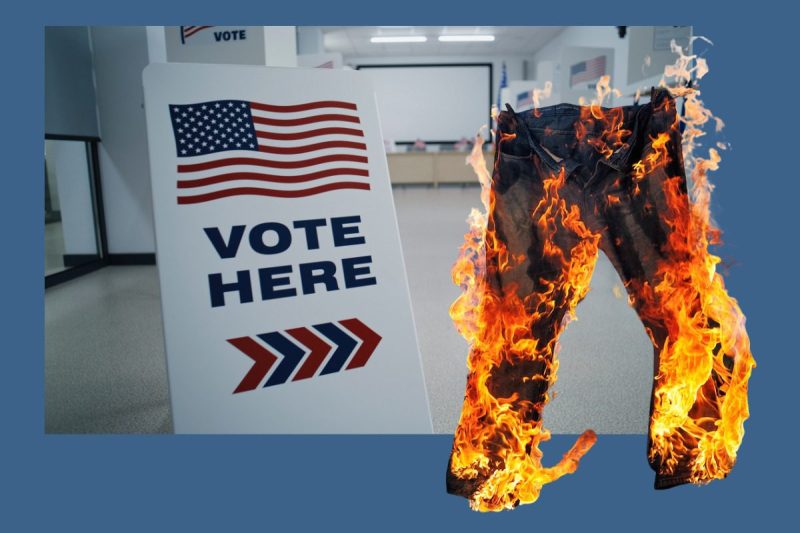
President Trump reposted a video worthy of a “pants on fire” rating ignoring the difference between voter files and active voter registrations.
As happens more often than not, President Donald Trump made news with his fingers on a tiny keyboard and a small social media platform — this time, spreading a conspiracy theory about voter fraud and elections integrity in Wisconsin.
On his Truth Social account, Trump recently shared a video by Peter Bernegger, a mail fraud and bank fraud criminal, who has dogged Wisconsin election officials for years with false claims. The video contains a caption that would understandably catch a viewer’s attention: “Wisconsin has 7.14 MILLION registered voters… But only about 4 MILLION adults live in the entire state.”
Except that’s not the full story, by any means.
As reported by Votebeat, the Milwaukee Journal Sentinel, and others, Wisconsin does not lump everyone into a single Election Day voter database, filled with ineligible voters. There are “pollbooks,” which contain the 3.6 million currently active voters in the state, as vetted by the Wisconsin Elections Commission, and there are 4.6 million inactive voter records.
The inactive records arise for a number of reasons, which logically explain why voters’ records are no longer on the active pollbooks: they’re dead, they moved, they registered in another state, they’ve had their voting rights suspended due to a felony conviction, they have been declared mentally incompetent by a court, or they are simply declared inactive because of numerous attempts by the commission to confirm their eligibility to remain in the pollbook.
MORE: See all UpNorthNews coverage about voting in Wisconsin
While Bernegger gets attention for making it sound as if an ever-growing voter database is suspicious, he fails to make clear there is a subset of confirmed, active voters. If the inactive voters — the living ones, anyway — showed up at a polling place on an election day and expected to vote immediately, they would be denied. They would have to re-register with proof of identification and residency.
By keeping the expired records in the larger voter database, officials have something to compare when someone tries to use that person’s name to vote. Contrary to what Bernegger suggests, without the old records, it could be easier for a fraudulent voter to cast a ballot. But to be clear, fraudulent voting in Wisconsin is so rare as to be practically, statistically non-existent.
“It’s actually pro-list hygiene to have access to that information immediately,” said Wisconsin Elections Commission Chair Ann Jacobs to Votebeat.
Making voting easier — or harder?
In the Trump era, Democrats and Republicans go in decidedly different directions when it comes to election integrity. Democrats note the safety and accuracy of current elections, while seeking new ways to make voting rights accessible. Republicans have been more focused on casting doubts about election security and concocting new ways to make voting less convenient or nearly impossible for some populations.
US Rep. Bryan Steil (R-Janesville) has introduced a new series of proposals attacked by critics as new attempts at voter suppression. Under the guise of “reform,” Steil’s package would require further proof of US citizenship, something already required to register, even as noncitizen voting is already next to non-existent. There would be increased requirements for voters to show photo IDs at polling places, even though photo ID is already required to register. The proposal would also ban mail-only elections, ban ranked choice voting, place sharp restrictions on a person’s ability to collect ballots on behalf of other people like the elderly and disabled, erase the grace period allowed by some states to count absentee ballots if they have been postmarked by Election Day and arrive within a set number of days afterward. Another provision would not allow mail-in ballots to be counted until after the polls close, increasing private citizens’ ability to target communities that vote in ways they don’t like by allowing them to sue election officials whom they allege have allowed noncitizens to vote.
In the Legislature, Democrats have introduced their own election reform bills that have nothing in common with what Steil has submitted in Congress. The Democrats’ bills include allowing local election clerks to begin processing (but not counting) absentee ballots the day before an election, to reduce the likelihood of late-night results. Other proposals would provide more grants for local governments to pay for election administration, new gun restrictions near polling places, easier residency requirements for people who move close to election days, increased use of college student ID’s for voting, and participation in a national popular vote compact which would bypass the Electoral College if enough states agreed to it.
Rep. Lee Snodgrass (D-Appleton) asked the chair of the Assembly Elections Committee when any of the 25 Democratic bills in his committee would at least get the courtesy of a public hearing, if not a vote. Snodgrass told UpNorthNews the answer from the office of Rep. Dave Maxey (R-New Berlin) was that there would be no hearing.
“We were told the Republican priorities for this session had been met and at this time there were no plans to meet,” Snodgrass said.
The legislative session for 2025-26 is expected to end later this month.