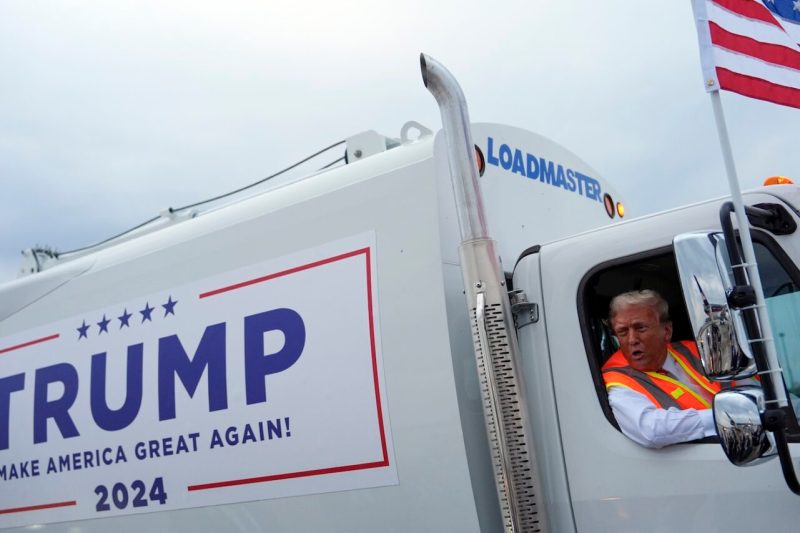
The president says he’ll bring down inflation, which is already coming down, and build manufacturing, which is already on the rise in Wisconsin. His economic promises could short-circuit job growth and raise consumer prices.
President Donald Trump, having won a second term by hammering at voter concerns about inflation, promised in his inaugural address Monday that he would bring price growth down and push manufacturing job growth up. But those things are already happening in Wisconsin, and some of the solutions he pitched to a crowd in the US Capitol Rotunda could threaten the state’s leading-edge growth in several new industries.
“America will be a manufacturing nation once again,” Trump proclaimed.
Wisconsin is already a manufacturing state, with nearly 9,000 manufacturing companies that employ nearly a half-million Wisconsin workers and generate an estimated $66 billion in economic output, according to Gov. Tony Evers’ office.
Trump, who at age 78 is the oldest person to ever take the oath of office, often appears trapped in an earlier age when talking about manufacturing jobs—promising to restore old-line car manufacturing to Detroit and resurrecting the coal mining industry, for example—and he reaffirmed his position that manufacturing jobs would grow through a policy of “drill, baby, drill” and having “the largest amount of oil and gas of any country on Earth, and we are going to use it.”
It’s a policy that stands in contrast to a new generation of jobs based in cleaner energy sources, with jobs in research, manufacturing, and engineering that are growing quickly in Wisconsin—more than 73,000 as of 2023, according to a report compiled by Clean Jobs Midwest.
Evers and the Wisconsin Economic Development Corporation say Wisconsin is becoming a worldwide player in the manufacturing of electric vehicles (EVs) and related equipment—opening opportunities for electrical engineers, industrial engineers, and computer programmers more than in many states.
While Trump claims he will “revoke the electric vehicle mandate” so that consumers “will be able to buy the car of your choice,” he is not attacking a manufacturing rule so much as a pollution rule. Consumers are already choosing EVs, with tens of thousands registered in Wisconsin among the more than 3 million being used nationwide.
Trump could also end up interfering with consumer choices in cars and nearly every other product with his promise of significant tariffs. In his inaugural address, the president again made the false claim that tariffs are taxes on foreign governments when they will instead be an additional import tax on American consumers who want to choose goods made elsewhere.
Another way Trump could harm Wisconsin job growth and household finances is by attempting to roll back President Joe Biden’s Inflation Reduction Act, which is making record investments for manufacturers, homeowners, businesses, and local governments to upgrade their energy systems and lower their utility bills.
“I think it would definitely be a detriment to the programs that were in development. They would be stymied if there wasn’t the grants and funds available,” said Mark Boehm, a project foreman with the International Brotherhood of Electrical Workers, on a November UpNorthNews Radio segment about the growth in union jobs in Wisconsin.
Not only does Wisconsin already have a healthy manufacturing sector, the state is setting new records for full employment month after month (3,073,900 employed at last check) and saw a record low 2.4% unemployment rate last year as well as a labor participation rate higher than the national average, according to statistics shared by Evers.